News
The stories behind the science: SANTHE researchers learn from the best
Behind scientific research are personal experiences that rarely make it into a conference presentation or journal article. For four members of the SANTHE community, a Moth storytelling workshop in Nairobi, Kenya, offered an opportunity to explore those stories and learn how to share them. It is imperative that scientists share personal stories as narrative communication builds public trust, humanises researchers, and makes complex data understandable. While traditional science relies strictly on objective facts, personal stories bridge the gap between abstract research and human experience.
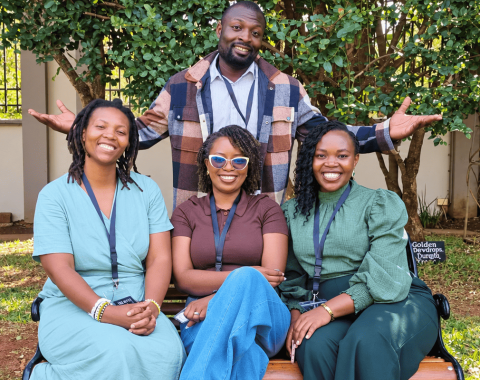
ANTHE Masters Fellows Loice Kanda, based at the KEMRI-Wellcome Trust Research Programme (KWTRP), Kilifi, Kenya, and Modeste Ngamaleu, based at Centre de Recherches sur les Maladies Émergentes et Ré-émergentes (CREMER), Yaoundé, Cameroon, alongside SANTHE alumnae Kawela Mumba, Center for Family Health Research in Zambia (CFHRZ), Lusaka, Zambia, and Lerato Mtshali , Africa Health Research Institute (AHRI), attended the workshop from 29 September to 1 October 2026. Organised by The Moth – a global nonprofit organisation dedicated to the art and craft of true personal storytelling – in partnership with the Gates Foundation, the programme helped researchers working across TB, HIV and malaria, find the human stories behind their science and communicate with audiences beyond the laboratory.
Their stories touched on perseverance, loss, identity and trust. Loice reflected on balancing her master’s studies with a demanding job, while Modeste shared how losing his mother and younger brother to HIV helped motivate his research. Lerato explored her journey as a traditional healer and how it informs her ambition to connect traditional medicine with biomedical research.
For Kawela, the story began with a teenage girl who remained reluctant to receive the HPV vaccine despite being given For Kawela, the story began with a teenage girl who remained reluctant to receive the HPV vaccine despite being given scientific facts. The encounter prompted her to consider why a mother’s warning carried greater weight than a scientific explanation – and to listen more closely to how families make health decisions.
Through practical exercises, participants learnt to shape their experiences into stories, deciding what to include and how to engage an audience.
Reflecting on the workshop, Loice said: “It reminded me how much can be hidden behind the people we meet every day.
For Lerato, the lesson extended beyond presenting research: “Our stories have the power to transform lives, influence policy, and to heal ourselves and others. We should not be afraid to share them.”
The participants hope to carry these lessons into conference presentations, community engagement, and conversations about their research, keeping the people behind the science visible.