News
Botswana drives HIV Cure research agenda at second symposium
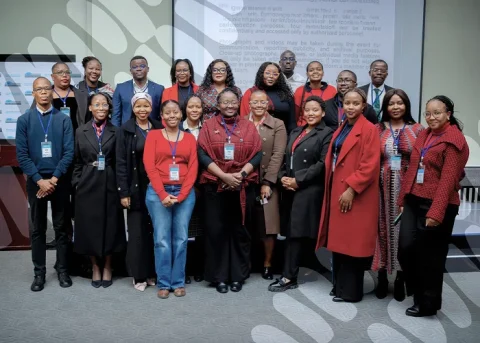
Researchers, clinicians, policymakers, community representatives and development partners gathered in Gaborone on 15 July 2026 for the HIV Cure Symposium, hosted by SANTHE’s partner site – the Botswana Harvard Health Partnership (BHP). Held at Cresta Lodge, the symposium drew over 100 key stakeholders and showcased the latest advances in HIV cure research while strengthening the partnerships needed to accelerate progress towards ending the HIV epidemic.
Convened by Catherine Koofhethile, SANTHE Path-to-Independence Awardee and Principal Investigator of BHP’s adolescent HIV cure research programme (the Phodiso Study), the symposium highlighted Botswana’s growing leadership in HIV cure science. The programme spanned basic laboratory research, virology, clinical trials and community engagement, demonstrating how collaboration across research institutions, government, healthcare providers and communities is driving scientific discovery into meaningful health outcomes.
Delegates explored the latest developments in HIV treatment and cure research, including promising new scientific approaches to overcoming viral persistence. The keynote address, “Single Cell Profiling of Host Features Impeding on Viral Persistence,” was delivered by Malika Aid Boudries, Assistant Professor of Medicine and Principal Investigator at the Center for Virology and Vaccine Research at Harvard Medical School, Boston, USA, whose work focuses on computational pipeline analysis and epigenetic profiling. Her address examined how single-cell profiling can deepen understanding of the host factors that enable HIV to persist.
Throughout the day, participants engaged with a rich programme of BHP-led research presentations, opening with a look at the progress Botswana has made in HIV management to date, before turning to HIV reservoir and immune profile studies among infants, adolescents and young adults living with HIV. Lightning talks from the Koofhethile lab featured preliminary data from research assistants, a data manager and research fellows working on the Phodiso Study, alongside updates from clinical trials such as the Tatelo Plus Study (IMPAACT 2042), which is evaluating viral control in children receiving combination broadly neutralising antibodies. Additional sessions examined community perspectives on analytical treatment interruption studies, HIV transmission dynamics, molecular epidemiology, drug resistance, and innovative approaches to strengthening HIV prevention in Botswana.
Recognising that scientific breakthroughs must be matched by meaningful community participation, the symposium also placed a strong emphasis on community engagement in HIV cure research. Presentations explored strategies for building authentic partnerships with communities, while a personal testimony from Ms Sekgabo Seselamarumo offered a powerful, lived reminder of the human impact of HIV and the importance of sustained investment in cure research. Discussions culminated in a multidisciplinary panel addressing a pivotal question: is Botswana ready for the next phase of HIV cure research? Scientists, healthcare professionals, regulators and community representatives each contributed their perspectives on the opportunities and challenges ahead.
The symposium concluded with reflections from key collaborators, including representatives from the Botswana-Baylor Children’s Clinical Centre of Excellence, the Ministry of Health, the Ministry of Communications and Innovation, and the Ministry of Local Government and Traditional Affairs. Stakeholders reaffirmed that an HIV cure can only be achieved through bold interdisciplinary collaboration, sustained investment in training, research and innovation, and meaningful engagement with communities.
Koofhethile described the day as an affirmation of the programme she has spent years building:
“Reflecting back, I think people were enthusiastic about attending the symposium, and learning more about HIV Cure Research. Also, the questions and discussions showed interest and that they now have a better appreciation of the science. Participants really appreciated that this work was being done locally, by Batswana. I was also humbled that I was able to stand on stage with my students and the rest of my team, who have been training in the past two years, showcasing their preliminary work and having the clinical team share study progress, recruitment challenges and the new collaborative developments that will improve the recruitment progress. I was also humbled to hear from collaborators stressing collaborations over competition and that we cannot achieve anything alone, and that was important for me.”
She emphasised that eliminating HIV remains one of the greatest scientific challenges of our time, requiring the collective expertise of researchers, clinicians, policymakers, implementers, communities and development partners. She closed by inviting all stakeholders to the upcoming “Setting the HIV Cure Agenda Meeting for Botswana,” supported by SANTHE, which will help shape the country’s future priorities for HIV cure research.
Cornelius Gaetsaloe, Director for Business Development and Sponsored Awards at BHP, pointed to the partnerships forged on the day and the pipeline of talent driving the work:
“Opportunities for deeper collaborations were established. Avenues for sharing and leveraging resources, methodologies and learning were strengthened. Accelerating the development of the next generation of Cure and Ageing researchers was highlighted as integral to HIV Cure.” He noted that questions of sustainability and continuity of support for BHP’s cure programme were also raised, tied to the need to broaden partnerships and funding bases. “Development partners present praised BHP for the groundbreaking HIV Cure work, and I was left with a swelling sense of pride and great admiration for the young Batswana scientists leading HIV Cure,” he said, adding that a young person living with HIV had shared her belief that a significant breakthrough would be realised within the next decade.
Gaerolwe Masheto, Executive Director of BHP, framed the symposium as a marker of how far the field has come:
“My takeaway from the BHP 2026 HIV Cure Symposium is that the question is no longer whether an HIV cure is possible, but how quickly we can make it a reality. Science is advancing at an unprecedented pace, but science alone is not enough. A cure will be achieved through bold collaboration across disciplines, sustained investment in training, research and innovation, meaningful engagement with communities, and the determination of researchers, clinicians, policymakers, and people living with HIV working together toward a common goal.”
Ernest Moseki, Community and Stakeholder Coordinator at BHP, welcomed the balance struck across the programme: “The presentations were balanced: science, perspectives from partners, regulatory agencies, MoH and community. The panel discussion summarised the symposium very well.”
Kennedy Mupeli, Programme Manager at CEYOHO, said the symposium underscored the need to look past Botswana’s existing HIV successes: “The Botswana HIV Cure Symposium was both inspiring and thought-provoking. My key take-home message is that while Botswana has made remarkable progress towards the 95-95-95 targets, we must now look beyond these achievements and invest in HIV cure research. Achieving this will require strong partnerships between researchers, healthcare providers, policymakers, and communities, ensuring that people living with HIV remain at the centre of the research journey.”
Dineo Thebe, Operations Director at BHP, reflected on what the day revealed about the country’s readiness: “Today I witnessed a pragmatic and robust exchange among scientists, researchers, clinicians, community leaders, activists and government officials. This dialogue offered a valuable insight into our collective readiness for what I believe to be the next game-changing, life-transforming strategy in HIV research: the pursuit of a cure. The symposium not only showcased the exceptional, behind-the-scenes work taking place in our labs and highlighted the critical role of ethics bodies and research partnerships, but it also underscored our national preparedness to embrace this HIV Cure strategy. The key discussions centred on local funding, resource mobilisation and how institutions can effectively collaborate to maximise impact, even within resource-constrained settings. The community, particularly adolescents and young adults, were identified as a central catalyst in turning the vision of an HIV Cure into reality.”
Taken together, the day’s discussions reinforced a shared conviction among researchers, clinicians, funders and community leaders alike: that ending HIV in Botswana will depend as much on partnership, investment and community trust as it does on scientific breakthrough.